📖 Source→⚡ Observation·Where the pattern works/Where the pattern breaks·Interpretation ≠ Conclusion

Resources

K12

⏱ 5 min

Teachers tend to work in isolation on their own islands, keeping their learning to themselves, yet they also generously share resources with one another. It is this latter trait that is becoming increasingly important as the role of the educator continues to expand. As educational technology research specialist Stephen Downes observes, the expectations on teachers have grown from “being expert in the discipline of teaching and pedagogy…[to needing to have] up-to-date and relevant knowledge and experience in it. Even a teacher of basic disciplines such as science, history or mathematics must remain grounded, as no discipline has remained stable for very long, and all disciplines require a deeper insight in order to be taught effectively.” It is no longer possible for an educator to work alone to fulfil each of these roles: the solution is to work and learn in collaboration with others. This is where peer-based sharing and learning online, connected/networked learning, or peeragogy, can play an important role in helping educators.

Becoming a connected/networked learner

The following steps are set out in ‘phases’ in order to suggest possible experiences one may encounter when becoming connected. It is acknowledged that every learner is different and these ‘phases’ only serve as a guide.

Phase 1: Deciding to take the plunge

To help educators begin to connect, the Connected Educator’s Starter Kit was created during Connected Educator’s Month in August 2012. This chapter previews the main steps. The first step to becoming a ‘connected educator-learner’ involves making the commitment to spending the time you’ll need to learn how to learn and share in an open, connected environment.

Phase 2: Lurking

We start off as lurkers. A learner can be considered a true ‘lurker’ after reviewing the starter kit, establishing a digital presence (through a blog or a wiki) or signing up for Twitter and creating a basic profile containing a photo. In this phase, lurkers will begin to ‘follow’ other users on Twitter and observe educational Twitter ‘chats’. Lurkers will also begin to seek out other resources through blogs, Facebook, Edmodo and LinkedIn groups.

Phase 3: Entering the fray

The lurker begins to develop into a connected educator-learner once he or she makes the decision to enter into a dialogue with another user. This could take the form of a personal blog post, participation on an education-related blog or wiki or an exchange with another Twitter user. Once this exchange takes place, relationships may begin to form and the work towards building a Personal Learning Network (PLN) begins.

One such site where such relationships can be built is Classroom 2.0, which was founded by Steve Hargadon. Through Classroom 2.0, Steve facilitates a number of free online learning opportunities including weekly Blackboard Collaborate sessions, conferences, book projects and grassroots cross-country educational-transformation tours. Classroom 2.0 also offers a supportive Social Ning—a free, social learning space that provides online conferences and synchronous and recorded interviews with inspirational educators—for connected educator-learners around the world.

Phase 4: Building and shaping your PLN

Just as not every person one meets becomes a friend, it is important to remember that not every exchange will lead to a co-learning peeragogy arrangement. It may be sufficient to follow another who provides useful content without expecting any reciprocation. It is dependent on each educator-learner to determine who to pay attention to and what learning purpose that individual or group will serve. It is also up to the learner-educator to demonstrate to others that he or she will actively participate.

There are a number of strategies one can use when shaping the PLN to learn. However, one of the best ways educators can attract a core of peeragogues is by sharing actively and demonstrating active and open learning for others.

There are a number of sites where a new educator-learner can actively and openly learn. In addition to personal blogging and wikis, other professional development opportunities include open, online courses and weekly synchronous online meetings through video, podcasts or other forms of media.

Examples include: Connected Learning TV, TechTalkTuesdays, VolunteersNeeded, SimpleK12, K12 Online, CEET, and EdTechTalk.

Alternatively, courses are offered with P2PU’s School of Education or a wide variety of other opportunities collected by TeachThought and Educator’s CPD online. Peggy George, the co-faciliator of the weekly Classroom 2.0 LIVE Sessions, created a livebinder package of free ‘PD On Demand’ connected professional development online options for peeragogy enthusiasts.

Phase 5: Extending the digital PLN and connecting face-to-face

Over time, once the connected educator-learner has established a refined PLN, these peeragogues may choose to shift their learning into physical learning spaces. Some options available for these educator-learners would include the new ‘grassroots unconferences’, which include examples such as: EduCon, EdCamps, THATcamp and ConnectedCA.

These (un)conferences are free or extremely low-cost and focus on learning from and with others. These ‘unconferences’ are typically publicized through Twitter, Google Apps, and Facebook. Connecting face-to-face with other peeragogues can strengthen bonds to learning networks and help to promote their sustainability.

Postscript

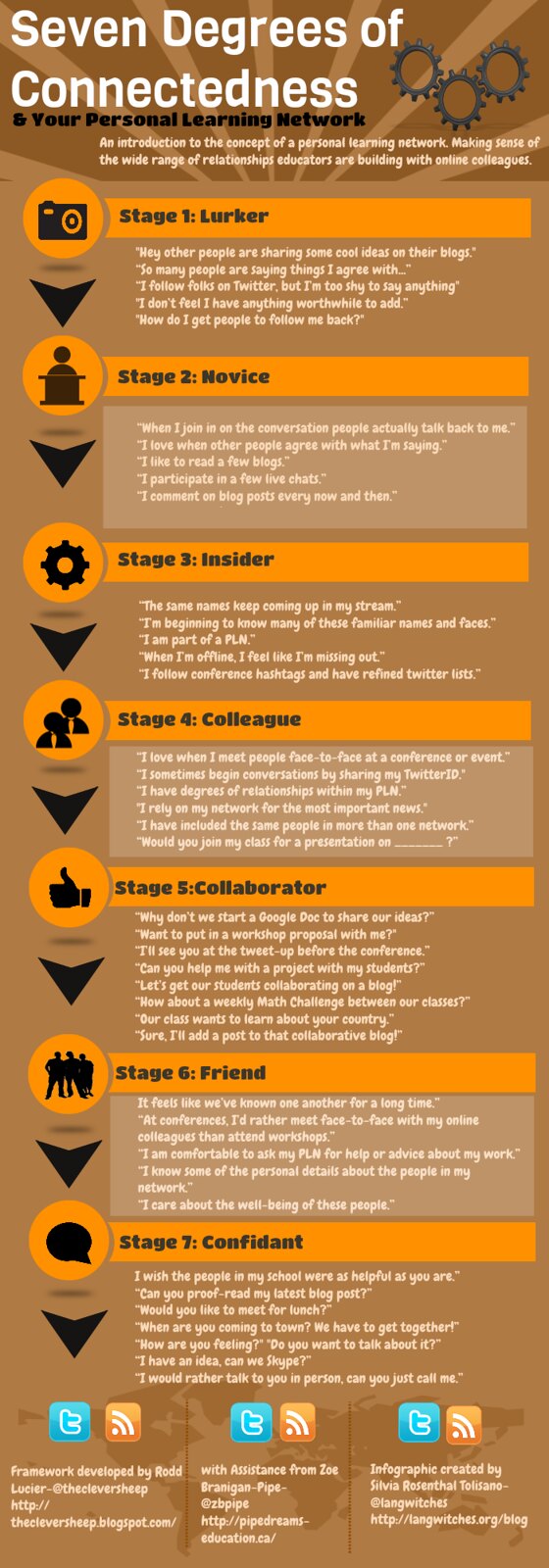
Sylvia Tolisano, Rodd Lucier and Zoe Branigan-Pipen co-created an infographic which explores the experiences individuals may encounter in the journey to become connected learners through another related sequence of steps: Lurker, Novice, Insider, Colleague, Collaborator, Friend, and Confidant. Googlize it, and have a look at our Recommended Readings in Chapter 31 for additional resources.
⚡ Unpeeragogy · Friction · Observation

K12 Doesn't Need Peeragogy

⏱ 4 minaudit-v2k12educationschool

The Assumption

Peeragogy in K12 settings is nearly impossible due to compulsory attendance and fixed curriculum, with teachers maintaining control that hinders peer learning. Institutional authority is fundamentally incompatible with peer-to-peer learning dynamics, and peer methods can transform the classroom if given space.

Operational Reality

The teacher locks her classroom door at 3:15 PM and drives home with a stack of papers to grade. Twelve years in. The district mandated a new reading curriculum this fall — the third change in five years. She attended the required training, nodded through the PowerPoint about “collaborative learning environments,” then closed her door and taught the way that works for her kids. Not because she is stubborn. Because she has earned the right to know what holds.

The Peeragogy Handbook celebrates teachers who “generously share resources with one another.” True enough. Teachers swap worksheets, trade classroom management tips, pass along which substitute actually shows up. But this is not peeragogy — it is survival. The sharing happens despite the system, not because of it. When your evaluation depends on test scores and your principal changes every two years, you do not experiment with peer learning circles. You protect what works. The friction is not accidental.

GitLab shows that clear boundaries between authority and community can create protected peer spaces even within hierarchical structures. Drupal shows that moving from institutional authority to peer governance requires structural redesign, not just permission. arXiv demonstrates that even the most peer-driven systems need validation mechanisms that look like authority.

Perturbatore: “What if you cannot peer-learn your way out of a report card — and the isolation is not the bug but the feature, the only space left where teaching can happen without measurement?”

Empirical Evidence

Resilience Cases (Confirming):

  • GitLab Stewardship Handbook — Explicit documentation of governance boundaries between corporate sponsor and community reduces friction in open-core projects. Clear boundaries between authority and community can create protected peer spaces even within hierarchical structures.

Fracture Cases (Complicating):

  • Drupal Governance — Intentional governance transition from BDFL to community model required years of structural work, not organic emergence. Moving from institutional authority to peer governance requires structural redesign, not just permission.
  • arXiv Endorsement System — Peer assessment systems in scholarly communication require endorsement hierarchies that contradict the egalitarian ideal. Even the most peer-driven systems need validation mechanisms that look like authority.

Operational Heuristics

Positive Boundary: Apply this pattern when governance boundaries are documented explicitly and peer spaces are carved inside — not against — institutional frameworks. Clear boundaries between authority and community reduce friction.

Negative Boundary: Do not attempt peeragogy in K12 contexts without explicitly negotiating boundaries with institutional authority. The assumption that authority and peer learning are incompatible leads to unrealistic attempts that consume energy without producing sustainable change.

Epistemic Synthesis

The teacher who shares resources but refuses peer observation is not contradicting peer learning — she is distinguishing strategically between what can be shared (a worksheet) and what must be protected (the rhythm of actual teaching). The handbook’s vision of collaborative educators assumes a context that does not exist: time, trust, and freedom from external judgment. The friction is not accidental — it is the rational response to a system where individual accountability and collaborative innovation are in structural competition.

Perturbatore: “What if you cannot peer-learn your way out of a report card — and the isolation is not the bug but the feature, the only space left where teaching can happen without measurement?”

The door locked at 3:15 is not rejection. It is protection.

Evidence Status

Status Count
Confirmed cases 1
Cases under study 0
Unverified cases 0
Ambiguous cases 0

Traceability

Run: audit-v2 · Delta: 1.2 → 1.235 (±0.035) · Diversity D: 2

References

💬 Field Report: K12 Doesn't Need Peeragogy

Every pattern in the Handbook has been tested in the real world — and the real world usually has something to say about it. If you tried something similar, or saw it fail differently, share the story here.

Write in your native language — the browser will translate. Lowering the entry barrier is more important than choosing the "right" language. GitHub translates threads automatically so everyone can follow along.
Read how evidence is collected →

What happens after I share my story?

1. Your post appears in GitHub Discussions in the Field reports category.

2. Once a week, the project reads new threads and checks for patterns worth integrating.

3. If your story reveals a new Failure Vector, a revision to tension_index, or a sharper edge for the Perturbator — the entry gets updated.

4. The change is logged at /log and goes live on the next deploy.

Don't have a GitHub account? Here's how it works

GitHub Discussions is free. You need a GitHub account (30 seconds to create one).

Once you're signed in, click "Share your story" above. Write in your own language — the thread will be translated for everyone else automatically.

You don't need to know how to code. You don't need to know what "git" is. You just need an observation that the theory didn't match reality.

What are GitHub Discussions? →

Every pattern raises more questions than it answers.
Read the theory. Then look at what happened.