Peeragogy in Practice
Reduce, reuse, recycle
Motivation
This pattern can guide project participants in identifying and managing available resources.
Context
In a peer production context, you are simultaneously “making stuff” and building on the work of others.
Forces
Derivative: you don’t have to do everything yourself!
Sensemaking: resources are useful only when you can make sense of them.
Sharing: your understanding gains robustness when you share with others.
Problem
Many projects die because the cost of Reinventing the Wheel [c2] is too high. However, this is just one possible symptom of overfocus on a few priorities. Concerns may also arise if the project’s output is not actually used by anyone.
Solution
“Steal like an artist,” and make it possible for other people to build on your work too. In the Peeragogy project, we have used off-the-shelf and hosted software suited to the task at hand (including: Drupal, Google+, Google Hangouts, Google Docs, Wordpress, pandoc, Github, ShareLaTeX). Early on we agreed to release our Peeragogy Handbook under the terms of the Creative Commons Public Domain Dedication (CC0), the legal instrument that grants the greatest possible leeway to downstream users.[fn:1] This has allowed us and others to repurpose and improve its contents in other settings, including the current paper. Follow the steps indicated by the keywords in the pattern’s title:
- Reduce the panoply of interesting interrelated ideas and methods to a functional core (e.g. writing a book).
- Reuse resources relevant to this aim, factoring in “things I was going to have to do anyway” from everyone involved.
- Recycle what you’ve created in new connections and relationships.
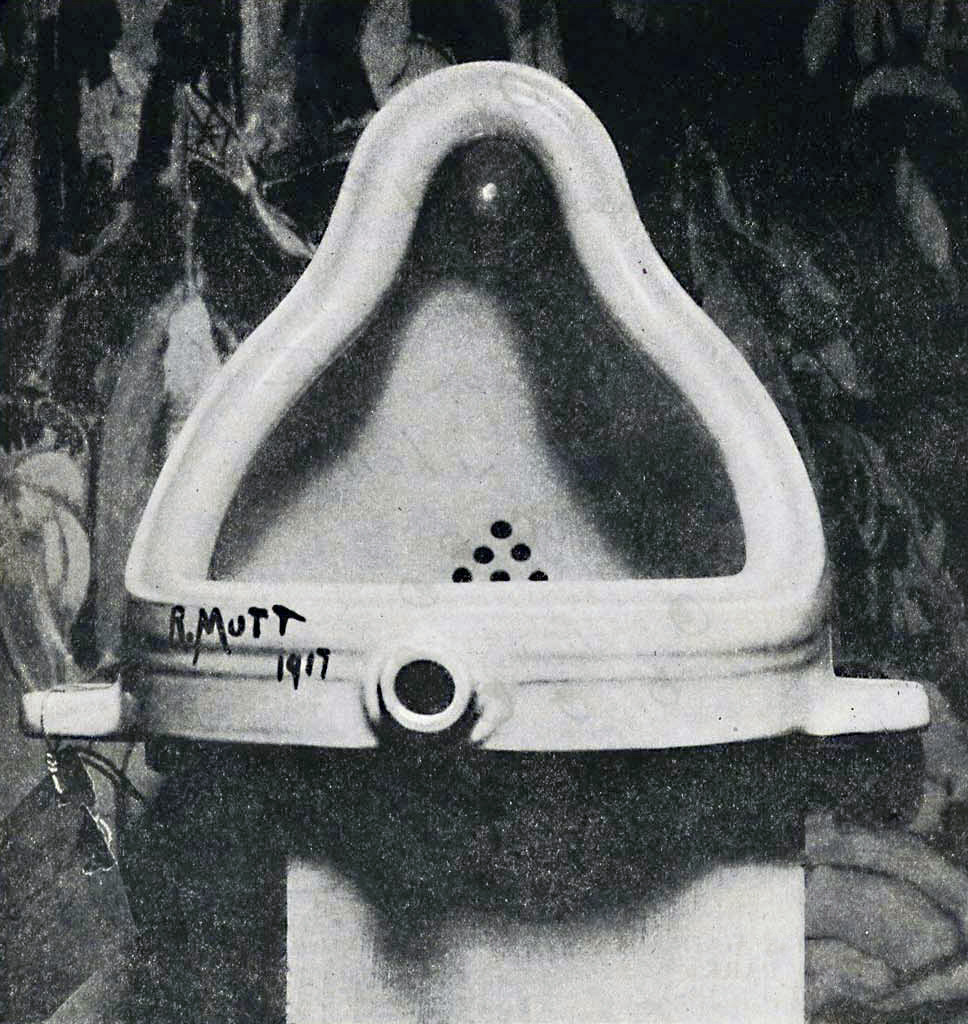 \
/A paradigmatic example of found-art. “Fountain by R. Mutt, Photograph
by Alfred Stieglitz, THE EXHIBIT REFUSED BY THE INDEPENDENTS”./
\
/A paradigmatic example of found-art. “Fountain by R. Mutt, Photograph
by Alfred Stieglitz, THE EXHIBIT REFUSED BY THE INDEPENDENTS”./
Rationale
Clearly we are not the first people to notice the problems with wheel-reinvention, including “missing opportunities, repeating common mistakes, and working harder than we need to.”[fn:2] As a guest in one of our hangouts, Willow Brugh, of Geeks without Bounds and the MIT Media Lab, remarked that /people often think that they need to build a community, and so fail to recognize that they are already part of a community.*[fn:3] converted our old pattern catalog from the *Peeragogy Handbook/ into this paper, sharing it with a new community and gaining new perspectives; could we do something similar again?
Resolution
Reweaving old material into derivative designs and new material into existing frameworks, we build deeper understanding, and carry out collective sensemaking. The project’s Roadmap develops by making sense of existing resources – including our worries and concerns. Often we only know what these are when we attempt to share them. Drawing on a wide range of resources boosts our collective Carrying capacity.
Example 1
Contributors are encouraged to recycle existing works that are compatible with the Wikimedia-wide Creative Commons Attribution-ShareAlike (CC-By-SA) license.[fn:4] Some sub-projects have been created purely to help repurpose other existing works in this way.[fn:5] On the downstream side, DBPedia is an important resource for the semantic web, built by collating data from Wikipedia’s “infoboxes.”[fn:6] themselves increasingly being populated automatically using information from WikiData.[fn:7] able to develop tools that reuse Wikipedia content in other ways [1,2], However, these research projects do not always result in a tool that is accessible to day-to-day users.
Example 2
The knowledge resources and collaboration tools currently available online are what make a low-cost, high-quality, formally-accredited future university conceivable. However, the available resources are not always as organized as they would need to be for educative purposes, so peeragogues can usefully put effort into Reduce, reuse, recycle’ing available resources into a functioning university Library.
What’s Next in the Peeragogy Project
Are there other educational resources and peeragogical case studies that we could fold into our work? Can we recycle material from the /Peeragogy Handbook/ into a format that is easier to understand and apply?
BACK Any miscellaneous follow up from paper for Special Issue of Futures Journal for Anticipation :paper:
BACK Do a CLA using collected peeragogy PARs as data :paper:
References
-
Silvan Reinhold. 2006. WikiTrails: Augmenting wiki structure for collaborative, interdisciplinary learning. /Proceedings of the 2006 International Symposium on Wikis/, ACM, 47–58.
-
Nathalie Henry Riche, Bongshin Lee, and Fanny Chevalier. 2010. IChase: Supporting exploration and awareness of editing activities on Wikipedia. /Proceedings of the International Conference on Advanced Visual Interfaces/, ACM, 59–66.
[fn:1] https://creativecommons.org/publicdomain/zero/1.0/
[fn:2] https://blog.wikimedia.org/2013/11/19/learning-patterns-new-way-share-important-lessons/
[fn:3] https://www.youtube.com/watch?v=NpyQfYVKfBI
[fn:4] https://creativecommons.org/weblog/entry/15411/
[fn:5] https://en.wikipedia.org/wiki/Wikipedia:WikiProject_Mathematics/PlanetMath_Exchange
[fn:6] http://wiki.dbpedia.org/